

Safe Freight Calculator
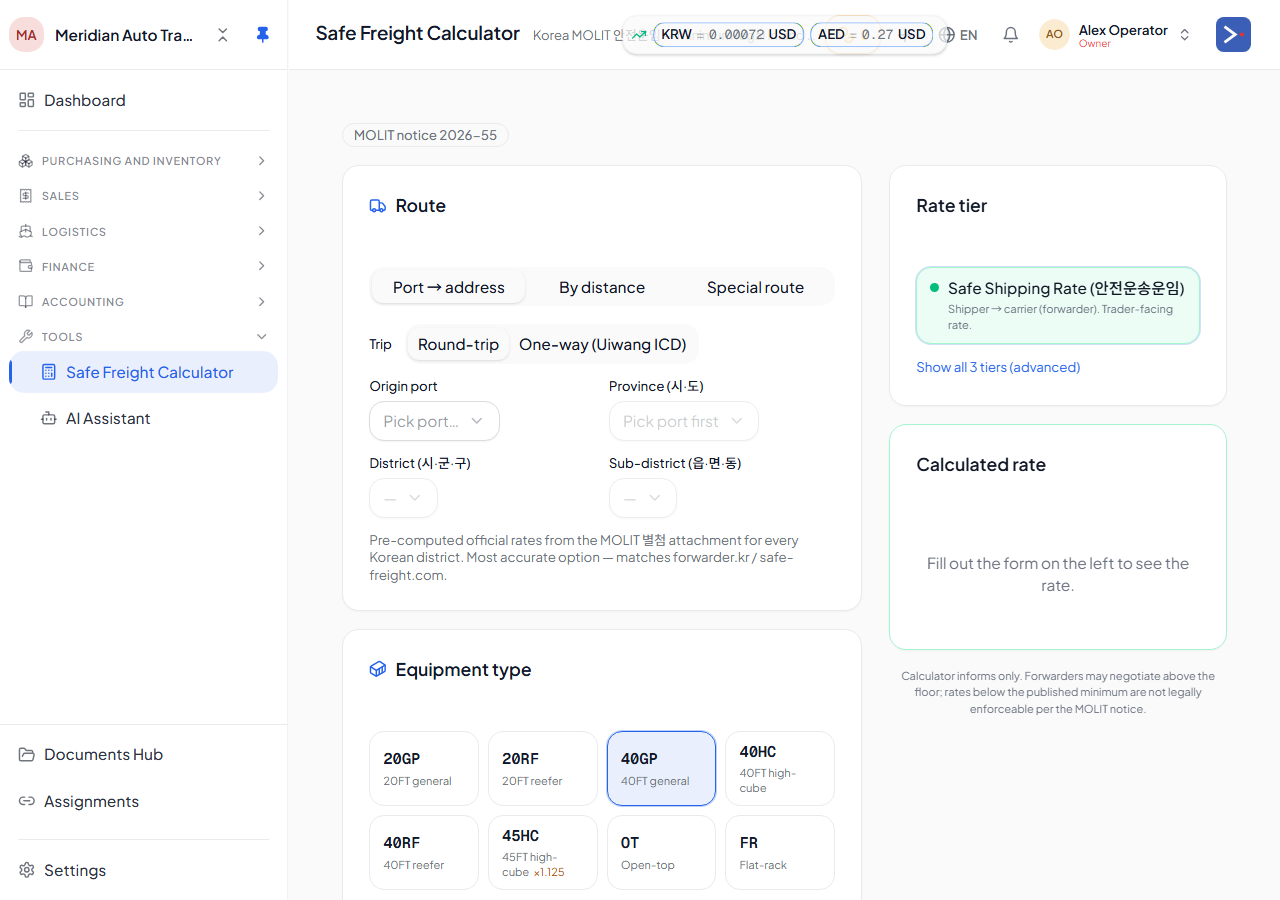
The Safe Freight Calculator (/tools/safe-freight) works out Korea’s mandatory safe-freight (안전운임) inland trucking rate for a container move, based on the rates MOLIT (Korea’s Ministry of Land, Infrastructure and Transport) publishes each quarter. It’s a standalone tool — you don’t need a booking or a schedule to use it.
What it calculates
Section titled “What it calculates”Give the calculator a route and a container, and it returns the total rate in KRW, built from:
- A base rate looked up from the published table for the current (or a chosen) quarter.
- An equipment modifier — standard containers use the base rate as-is; a 45’ high-cube container is charged at 1.125× the 40’ rate.
- A trip-shape multiplier — a plain round trip is the baseline; one-way Seoul-metro moves, combined 20’×2 loads, bobtail runs, on-ground moves, repositioning, and rail-CY-direct moves each have their own published multiplier.
- Surcharges — you can add any surcharges that apply (stacked per the published rules, with the highest-value surcharge counted in full and the rest at half value, up to 3).
How to pick a route
Section titled “How to pick a route”You can look up a rate three ways:
- By distance — enter the segment distance in kilometers; the tool finds the matching published distance band.
- By special route — pick one of the short, fixed Busan/Gwangyang port-to-backyard routes, which have their own published flat rates.
- By origin/destination — pick an origin port and a destination (province / city-county / town), for routes covered by the published origin-destination table.
Using the calculator
Section titled “Using the calculator”-
Open Tools → Safe Freight Calculator.
-
Choose how you want to specify the route: distance, special route, or origin/destination.
-
Select the equipment type (20’GP, 40’GP, 40’HC, 45’HC, 20’RF, 40’RF, open-top, or flat-rack).
-
Select the trip shape that matches how the truck will actually run.
-
Add any surcharges that apply, and pick a rate tier (shipping / entrustment / between-carriers — shipping is the default).
-
Read the result: total KRW, plus the breakdown of base rate, equipment modifier, trip multiplier, and applied surcharges, so you can see exactly how the number was built.